The person's account
Keeping life together
'I want to keep my job and stay near my sister. The damp is making my son's breathing worse. Repairs appointments clash with my shifts. I've told three teams. I still don't know who can help.'
Relational public services · tools, writing, and practice
Practical tools, papers, and teaching on relational public services, demand, place-based working, and the conditions that let useful practice endure.
For individuals, teams, and place-based partnerships. No account required. Use an anonymised situation or the fictional example.
One life, three representations
Asha is a fictional teaching case. Each record below may contain accurate statements. The problem is that the account becomes less useful for organising a response to her situation.
The person's account
'I want to keep my job and stay near my sister. The damp is making my son's breathing worse. Repairs appointments clash with my shifts. I've told three teams. I still don't know who can help.'
The service record
Damp repair logged; appointment offered.
Tenant unavailable; appointment rearranged.
Housing advice referral made.
Respiratory concerns: advised to contact the GP.
The management report
Repair request responded to within target.
Advice referral completed.
No unresolved action assigned to this team.
Case closed.
The repair hasn't been shown to be complete. Her working hours, family support, and experience of repeated contact have dropped out of the management account. Asha, a relative, or a helpful worker may have to do the joining up.
That last sentence is an interpretation of the fictional case, not a reported outcome. Keep this distinction when working with real situations: record what you know, what you infer, and what you still need to find out.
This route is a prompt, not a prescribed process. Stages may repeat, run in parallel, or be absent. Mark those differences in your map.
Use your own situation
The tool takes you from an account of one situation to a proposed change, an authority agreement, and an experiment. It doesn't diagnose an organisation or certify that a proposal is safe, agreed, or effective.
Work at your own pace; allow about 35-50 minutes for a first pass, or use the facilitated session below. The time estimate is a planning suggestion. You can leave any field blank or write 'unknown'.
Don't enter names, addresses, clinical details, or identifiable case histories. Entries stay in this tab unless you choose device storage or export a file. The tool has no submission endpoint, no shared workspace, and no automated assessment.
From TRIP26 to this workshop
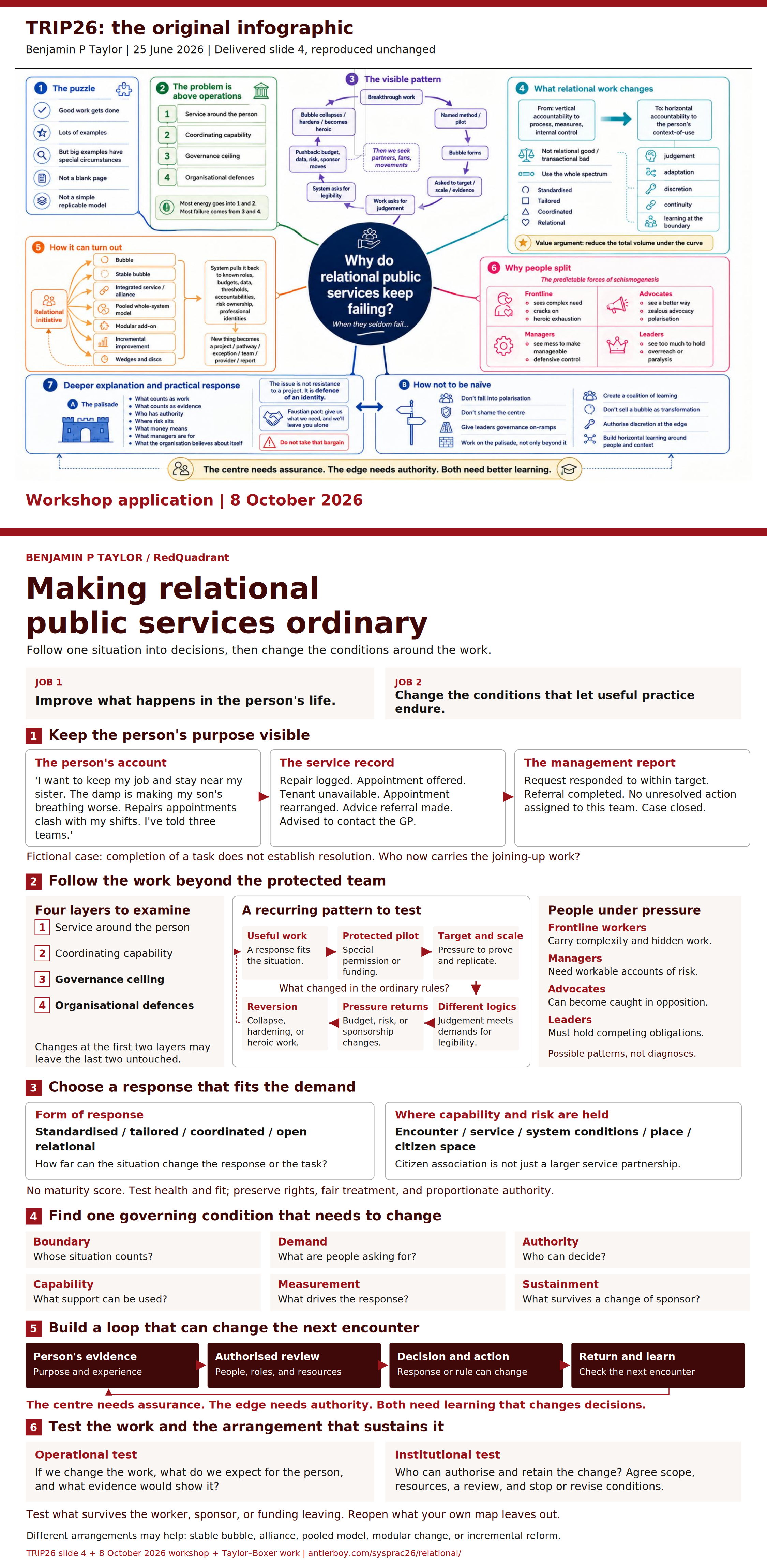
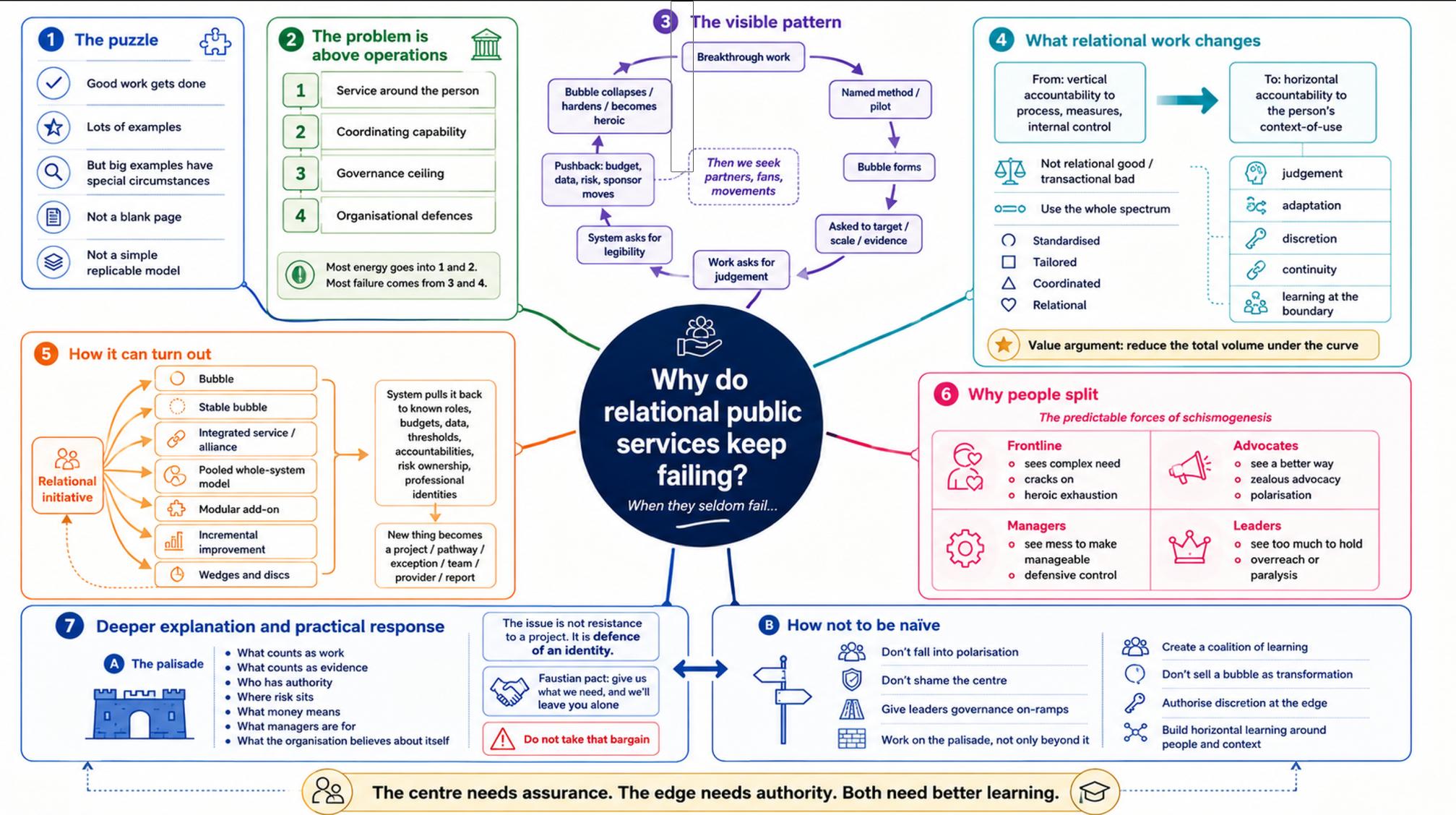
The TRIP26 infographic connected protected relational work, the governance ceiling, organisational defences, and the need for authority and assurance. The combined visual below contains the complete original TRIP26 graphic, unchanged, followed by a workshop extension. The extension adds the loss of meaning in Asha's case, the practical learning loop, and the distinction between a service experiment and an institutional one.
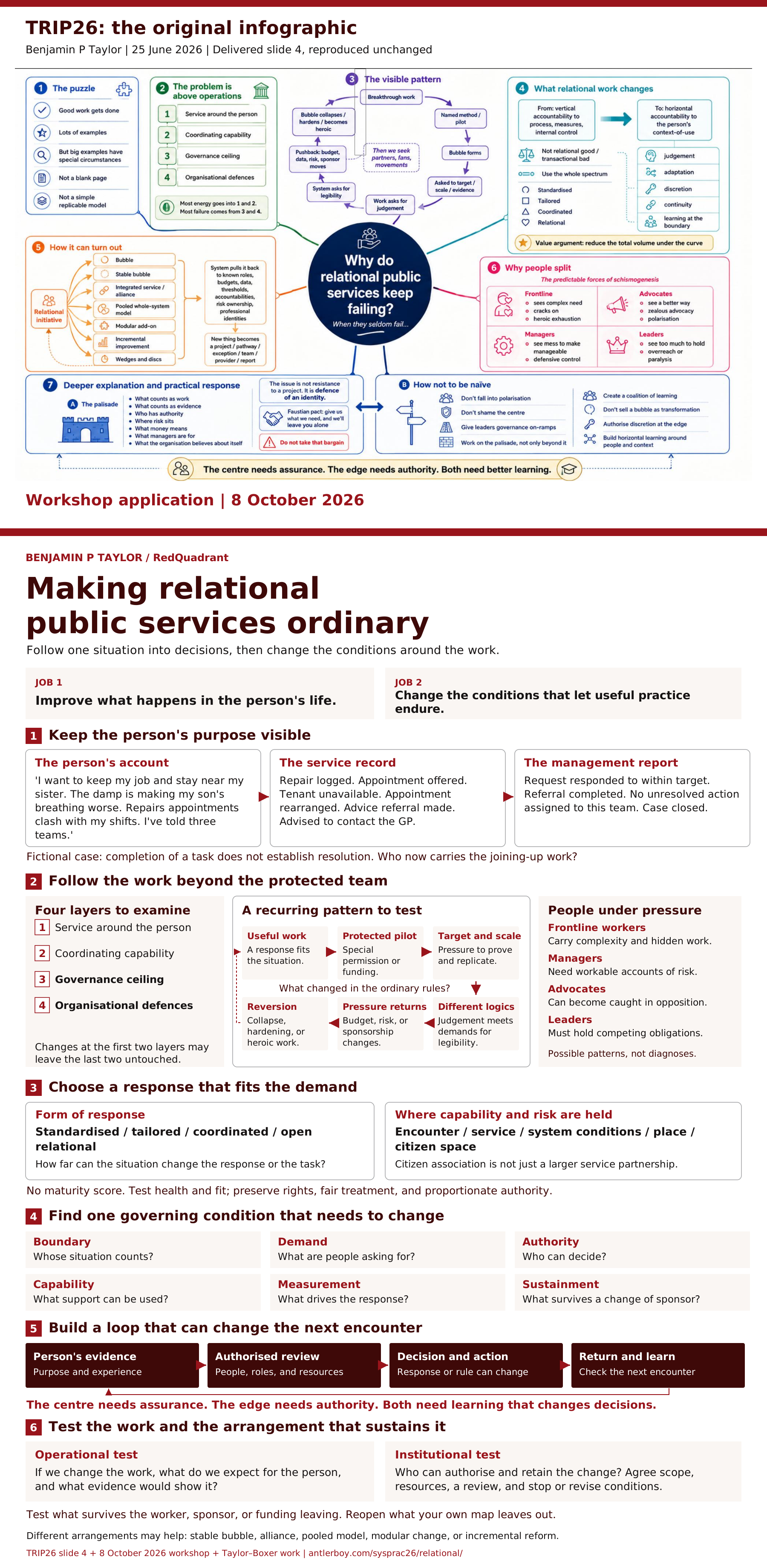
Improve what happens in the person's life, and change the conditions that let useful practice endure. In Asha's fictional case, work, family support, damp, and repeated contact become separate actions and a closed case. Ask what was lost and who now carries the joining-up work.
Service around the person; coordinating capability; the governance ceiling; organisational defences. Improving the first two doesn't by itself change the latter two. A protected response may face pressure to become a named, measurable, scalable offer; clashes over judgement, budgets, data, and risk can produce hardening, exhaustion, or closure. This is a pattern to investigate, not an inevitable sequence.
Frontline workers may carry extra work; advocates may become polarised; managers may intensify control; leaders may become overwhelmed. These are possibilities to explore, not diagnoses of individuals. Offer a way to govern the work without shaming those responsible for it.
Standardised, tailored, coordinated, and open relational responses serve different requirements. The scope may be an encounter, service, shared system conditions, place, or citizen association. Enforcement cuts across these choices. Ask whether the arrangement fits and avoids both neglect and capture; don't treat the model as a moral ranking or a maturity score.
Boundary: whose situation counts? Demand: what do people actually ask for? Authority: who can decide? Capability: what can they draw on? Measurement: what counts as success? Sustainment: what survives changes in sponsor, budget, or personnel? Money, risk, and learning run across these conditions.
Person's account and evidence → joint review with the necessary authority → a decision within explicit limits → changed response or rule → feedback about the next encounter. Record how the person can disagree, what assurance is needed, and where the unresolved question goes.
A bubble, stable bubble, alliance, pooled arrangement, modular addition, incremental improvement, or wedge into existing practice may each be useful. State what has actually changed. Test the operational hypothesis and the institutional arrangement. Name an owner, permission, review date, evidence, and stop-or-revise condition. Ask what your own map excludes.
The 8 October discussion
The session concentrated on how a person's account becomes a service record and a management decision, then on what would allow the response to change. The following points summarise discussion, not findings from an evaluation.
Asha had already told three teams. The discussion noticed that this signal was available but didn't produce a different response. Another flag or form may help; it still needs someone able to act on it.
Transcript: 50:38-52:12.
Participants questioned counting a request or referral as completion. One proposal was to ask the person whether the response had resolved the issue. This was a proposal to test, not an agreed policy or a rule that satisfaction overrides duties, rights, or other people's interests.
Transcript: 1:01:06 and 1:05:40-1:07:01.
The discussion moved from identifying a service lead to asking what stops the lead changing a measure. The 'strategy ceiling' names a limit beyond which existing assumptions or conditions aren't open to question.
Transcript: 1:02:10 and 1:07:01.
A worker or manager can make a fragmented arrangement work through extra effort. The session asked what happens when that person leaves, and how learning could change the organisation rather than remaining their private responsibility.
Transcript: 31:40 and 1:04:52.
Scope of the record. The supplied transcript stops during discussion of governing conditions, after the turn beginning at 1:07:01. It doesn't establish completion of the later loop-design and experiment exercises. Those stages are developed here from the supplied slides, with new worked examples and an online delivery design. Personal disclosures and named participant cases aren't reproduced.
Facilitator guide
The purpose is to help participants trace one situation into decisions and propose an authorised change to the conditions around the work. This session can produce a map and a proposal. It can't grant workplace permission or establish that the proposed change works.
Use two sustained breakout blocks with the same groups of three or four. Use chat and private reflection for short prompts. Keep the case and step-by-step instructions available inside the group; don't depend on the host's shared screen.
| Elapsed | What happens | What to protect |
|---|---|---|
| 0-6 | Welcome, purpose, and a one-sentence chat contribution | Choice of real, anonymised, or fictional case |
| 6-18 | Work through Asha's three representations | Distinguish an accurate record from a useful account |
| 18-22 | Brief the task and check everyone can access it | One case and one record per group |
| 22-40 | Stable groups: trace one situation and mark one loss | 15 minutes of work, plus 3 for entry and return |
| 40-47 | Debrief selected contrasts | The consequential loss, rather than every group's full story |
| 47-52 | Screen break | Five minutes away from the screen |
| 52-59 | Explain governing conditions, authority, and assurance | A worked example of a proposed change |
| 59-63 | Brief the second group task | Separate a proposal from an agreement |
| 63-79 | Same groups: propose one authorised learning loop | 13 minutes of work, plus 3 for entry and return |
| 79-86 | Test the proposals under pressure | Evidence, disagreement, and a route beyond the immediate team |
| 86-90 | Private next conversation and close | A named role, next step, and review intention |
90 minutes total; 5 minutes protected break; 85 minutes usable. Up to 10 minutes (11.8% of usable time) can be released from welcome (2), worked case (2), first debrief (2), governing-condition explanation (1), second briefing (1), and final shareback (2). Don't take this time from group work or the break. The plan is a new design, not a reconstruction of actual timings.
Ask participants to bring one situation involving repeated contact, a boundary, and a decision. They should remove identifying details. Make Asha available so nobody needs to disclose a live case. Check whether participants are here to learn, to recommend a change, or to take a decision; don't blur those mandates.
Open the tool and load Asha before the session. Rehearse switching between the case and working record. Confirm that participants can open the site from their work devices. A sheet of paper is an equivalent working surface. One group member may keep the group record, but this tool doesn't synchronise between browsers.
A producer should allocate stable groups, handle late arrivals, and manage return. Without a producer, prepare the groups in advance and avoid changing them. Keep an equivalent group in the main session for anyone unable or unwilling to join a breakout. Check the actual platform's behaviour; the transition allowance is a planning allowance, not a technical guarantee.
State that this isn't a place to decide an urgent safeguarding, clinical, or statutory case. Existing escalation arrangements continue to apply. Don't record small-group case discussions. Public shareback should describe patterns and proposals, not identify the people involved.
The idea. Organisations select and translate information. A person's purpose may become a category, a task, and a count. Each translation affects what the organisation will do next. The exercise isn't an accusation that the record is false or that the worker doesn't care.
Introduce it. 'Keep one situation in mind where useful work depends on an exception. We'll follow what happens to the person's account, then ask what would let the next response be different.'
Take a one-sentence chat contribution; don't run a full introduction round. Read Asha's account slowly. Show the three representations together. Ask only: 'Which important part of Asha's account is absent from the management report?' Wait for answers before asking what action the report makes likely.
A useful response. 'The clash with her shifts has become tenant unavailability, so another appointment could reproduce the same problem.' This identifies a change in meaning and a plausible consequence. 'The system is uncaring' is an interpretation to unpack, not an adequate map.
Likely confusion. Someone may argue that a better referral would solve everything. Ask what would count as completed help, and who would know whether it happened. Someone else may want a richer record of every life detail. Ask which missing detail would change the response. More data isn't automatically better understanding.
Transition. 'Now trace the same movement in one situation you can examine. Don't fill unknown stages with what ought to happen.'
Purpose. Move from a general complaint to a specific point at which the account no longer supports a useful response.
Visible task. 'Trace one situation from the person's account to the next contact.' Output: one annotated route. The group uses the tool's first three steps or paper. This is one cumulative mapping task, not a demand to finish the entire tool.
Within the 15-minute work period, allow about 2 minutes to choose a case, 8 to trace its route, and 5 to mark one loss and who carries its consequences. Keep the group together throughout. Put the stages in an accessible message or page before sending anyone out.
Worked example. Asha's account includes conflicting appointment and shift times. The record says 'tenant unavailable'; the dashboard treats the request as responded to. A repeated appointment is a plausible next event, but remains an inference. Annotate that difference.
Listen for. Strong maps use actual words, identify a decision, and preserve unknowns. Partial maps describe only the intended process. Ask, 'What happened in this case?' A map that ends at referral needs a question about the next encounter, not an instruction to invent it.
Debrief. Ask one group to name the loss, then another for a different mechanism. Ask who has to do extra work because of it. Don't require every group to narrate its full case. Distinguish burden carried by the person, a worker's workaround, and an authorised organisational arrangement.
Fallback. Keep the same task in the main session, with private notes and two volunteer accounts. Don't spend the work time fixing breakout membership.
The idea. A worker may know what would help but lack time, information, a budget, a decision right, or protection when a target is challenged. A manager may hold one of these but not control the other organisations involved. 'Get the service lead involved' is the start of an inquiry into authority, not its conclusion.
Introduce the six conditions: boundary, demand, authority, capability, measurement, and sustainment. Use them as lenses from which to select one constraint. Don't give the group six simultaneous questions. Money, risk, and learning cut across them.
Worked example. Suppose the proposed change is to record whether a repair has actually been completed rather than whether a request was answered. The frontline worker may be able to capture the evidence. The service lead may be able to change the dashboard. A contract or corporate definition may sit elsewhere. Those authorities must be checked; they aren't facts established by the fictional case.
The 'strategy ceiling' is the point beyond which a necessary condition isn't open to discussion or revision. It may be a budget rule, a success measure, a contract, or an assumption about whose problem this is. Ask for the actual condition and evidence that it is held in place.
Don't make the centre a villain. Assurance about public money, equal treatment, lawful action, and safety remains necessary. Ask what assurance would make a different decision defensible, without simply recreating the same proxy measure.
Transition. 'Choose one condition your proposal needs to change. Build a route from what the person experiences to someone authorised to act on that evidence.'
Visible task. 'Design one arrangement that can change your limiting condition.' Output: one proposed learning loop, with a decision agreement and a bounded test. Continue with the same group and case.
Use the 13-minute work period for choosing one condition (4), drawing the loop (5), and recording a test (4). Reveal these stages in order; they don't require separate breakout visits. The work may remain incomplete. Preserve the unresolved permission rather than writing a fictitious agreement.
Worked pattern. Evidence from the person and the work → review involving the affected person and a role with authority → decision → changed response → feedback about the next encounter. Add a route for evidence that challenges the rule itself. A review meeting without a decision right is not yet this loop.
Decision agreement. '[Role] can decide [what] within [limits]. They provide assurance through [evidence and review]. Questions outside that authority go to [role or forum].' Mark each permission as agreed, proposed, or unknown.
Likely confusion. 'Create a dashboard' names a product, not how evidence changes a decision. Ask who acts differently when the dashboard changes. 'Give citizens the power to close every case' was a discussion proposal, not a universal rule: test rights, disagreement, safety, and the possibility that people don't respond.
Debrief. Ask, 'What decision can now change?' Then, after hearing the answer, ask what happens when the evidence challenges the rule. Keep a distinction between immediate repair, a protected exception, and changing ordinary arrangements.
The idea. One experiment tests whether a changed response helps the person. Another tests whether the organisation can authorise, resource, learn from, and retain that response. Success in the first doesn't establish success in the second.
Operational example. 'If repair appointments can fit working hours, we expect fewer failed visits and less disruption to work; we will examine completed repairs and the person's account.' This is a proposed hypothesis, not a result or a proven saving.
Institutional example. 'Ask the roles responsible for scheduling and performance reporting to authorise a limited test, agree an evidence review, and decide whether the booking and closure rules should change.' Establish the actual permissions, scope, support, and review date before starting.
Ask participants to record one conversation needed next. Test whether the arrangement would survive the helpful worker, sponsor, or special funding disappearing. Ask what their own map and proposal make less visible; the tool is also a selective representation.
Evidence. Look for the person's experience, practical outcomes, repeat contact, displaced work, unintended harm, and whether a decision or rule actually changed. Fewer contacts alone don't establish improvement. Stop or revise when the agreed safety boundary is crossed, burden is displaced, or necessary permission isn't available.
Follow-through. Participants own the next conversation. A sponsor or authorised role should own any decision about a real test. Record the intended review before closing; don't promise a follow-up that nobody has agreed to run.
Related practical work
Start with the specific constraint. These links lead to existing tools, exercises, and teaching; they aren't all interactive applications. Your working record isn't passed to any linked site.
Use for a wider assessment of commissioning and change when one case reveals constraints beyond the immediate service. The place-based beta is a document for testing and comment.
A first orientation to the Compass. Check its data handling before entering any sensitive information.
Use before inviting the people who could change a governing condition. Clarify what is open, who decides, and what you each need.
Connect inquiry, evidence, and review to a decision rather than treating learning as an additional report.
Work with concern, resistance, and power without taking over the problem or hiding the disagreement.
Rehearse a response with a colleague before trying it in a consequential working relationship.
Explore the group processes and management practices needed to make an authorised learning arrangement workable.
A wider set of practical methods. Select against the task rather than adding methods for variety.
The current public reading route, including Taylor-Boxer papers. Separate response form, scope, health, and fit rather than assigning one relationality score.
Find the demand-management sampler, seven ways to save and improve, public-service business model, and related RedQuadrant material.
Explore wider systems methods where the situation calls for a different kind of inquiry.
Find source teaching and exercises. Continue through Chosen Path, Systems Community of Inquiry, and the Public Service Transformation Academy.
Provenance
Workshop sources. Benjamin P Taylor, 'Making relational, place-based public services ordinary', 8 October 2026: supplied transcript and compressed 'SysPrac26-Relational-PSTA.pptx'. The online plan below is a revised design for reuse, not a reconstruction of the live timings.
Earlier visual. 'Why do relational public services fail?', TRIP26, 25 June 2026, v1.1 as delivered, slide 4. The expanded visual retains its four layers, protected-work cycle, variety of institutional arrangements, human pressures, and authority-assurance-learning argument. The earlier public deck is linked from the relational public services library.
Wider framework. 'How to do relational public services - cheat sheet' and 'Demand analysis and relational public services - a framework' (November 2025); 'Contact-driven transformation' (January 2026); and the Taylor-Boxer work on degrees of relationality, the demand side, and the conditions needed for public learning. The public library holds the current reading route; these are conceptual and practice resources, not a validated scoring instrument.
New material. The browser tool, populated example beyond the quoted case, 90-minute online plan, proposed authority arrangements, tests, and stop conditions are new teaching adaptations. They are marked as proposals rather than workshop agreements or empirical results.
The fictional case and proposed arrangements illustrate the method. They are not evaluations of service outcomes.
Privacy. This page doesn't send working entries to a server. Optional storage uses this browser's local storage and isn't encrypted case storage. Exported files contain your entries; keep them accordingly. Links open separate resources with their own policies. Don't use the tool for identifiable case management or urgent decisions.
Updated: 8 October 2026 · v0.03 · Benjamin P Taylor / RedQuadrant. Built from the workshop and source materials with a clear separation between source account and proposed practice.